
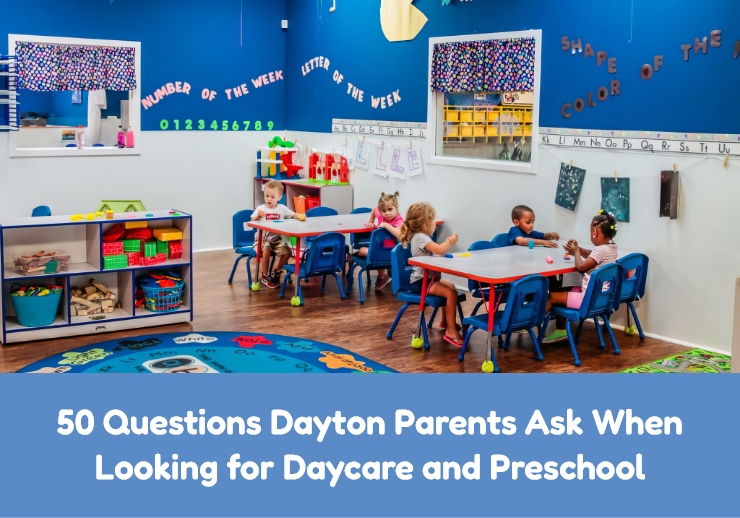
Finding the right daycare or preschool in Dayton can take time, especially when you are balancing location, work schedules, cost, availability, and what you want for your child’s early education.
Some families begin looking for infant care before their baby is born. Others need toddler care after a move or job change, are comparing preschool programs before kindergarten, or need a childcare center that accepts Ohio childcare assistance.
Whatever brings you to the search, knowing what to ask can make the process easier. Here are 50 common questions Dayton-area parents should consider when looking for daycare, infant care, toddler care, or preschool.
Finding Daycare in Dayton
1. How do I find a good daycare in Dayton?
Start by identifying licensed childcare centers that are convenient to your home, workplace, or daily commute. Then compare the programs offered, hours, curriculum, safety practices, teacher experience, parent communication, availability, and cost.
Online research can narrow your choices, but visiting a center is one of the best ways to determine whether it is right for your family.
2. How early should I start looking for daycare in Dayton?
Start as early as you reasonably can, particularly if you need infant care.
Infant classrooms have smaller teacher-to-child ratios and therefore fewer available spaces. Families who know they will need childcare after parental leave may want to begin researching and touring centers during pregnancy.
For toddler and preschool care, starting several months before your desired enrollment date can give you more choices.
3. How do I find daycare with openings near me?
Contact childcare centers directly and ask about availability for your child’s specific age and your desired start date.
Availability can change frequently. A center that is full today may have an upcoming opening as children transition into older classrooms.
When contacting a center, provide your child’s age, desired schedule, preferred start date, and whether you are interested in financial assistance.
4. Is it better to choose daycare near home or near work?
The best location depends on your family’s routine.
Daycare near home may make morning drop-off, evening pickup, sick-day pickups, and days when you aren’t working more convenient. A center near work may make it easier to reach your child quickly during the day.
For many Dayton families, the best choice is the childcare center that provides the right combination of quality, location, hours, and availability.
5. Should I choose a childcare center or home daycare?
Both can provide childcare, but the environments can be very different.
Childcare centers typically offer multiple classrooms divided by age, structured learning programs, larger teaching teams, established schedules, and opportunities for children to transition from infant care through preschool.
Home-based childcare may offer a smaller setting with children of different ages together.
Consider which environment, schedule, educational approach, and level of structure best fit your child and family.
6. What’s the difference between daycare and childcare?
Parents often use the terms interchangeably.
“Childcare” is a broad term for care provided while parents or guardians are working, attending school, or otherwise unavailable. “Daycare” commonly refers to center-based programs providing care during daytime hours.
Many modern daycare centers also incorporate early childhood education, meaning children are learning and developing throughout the day rather than simply being supervised.
7. What’s the difference between daycare and preschool?
Daycare typically emphasizes dependable full-day care, while preschool places additional emphasis on early learning and kindergarten preparation.
However, many childcare centers offer both.
A child can attend a full-day childcare program that includes preschool curriculum, hands-on learning, social development, early literacy, math, science, art, and other kindergarten-readiness activities.
8. How many daycare centers should I visit?
There is no required number, but visiting several centers can make your decision easier.
After seeing different classrooms and meeting different teaching teams, you’ll have a better understanding of what feels important to you.
Take notes after each visit so you can compare your impressions later.
9. What should I look for when touring a daycare?
Pay attention to what is actually happening in the classrooms.
Are teachers interacting with children? Do children appear comfortable and engaged? Are activities appropriate for their ages? Are classrooms organized and welcoming?
Also look at building security, cleanliness, outdoor areas, learning materials, classroom routines, and how staff members communicate with children and parents.
10. What questions should I ask during a daycare tour?
Ask questions that help you picture your child’s actual day.
Consider asking:
- What are your hours?
- What ages do you serve?
- Is there currently space for my child’s age?
- What curriculum do you use?
- What are your teacher-to-child ratios?
- How do you communicate with parents?
- How are naps and meals handled?
- What are your illness policies?
- How do you handle separation anxiety?
- What security procedures do you use?
- Do you accept Title 20 or other childcare assistance?
- What is required to enroll?
A good childcare provider should welcome questions from prospective families.
Infant and Toddler Daycare
11. When should I start looking for infant daycare?
If you know you will need infant care after maternity or parental leave, consider beginning your search during pregnancy.
Infant classrooms generally have fewer spaces than classrooms for older children, so starting early can give you more options.
12. What age can babies start daycare?
The starting age varies by childcare provider.
Some centers accept babies beginning in early infancy, while others have different minimum-age requirements. Ask prospective centers about their infant program and current enrollment policies.
13. What should I look for in an infant daycare?
Look for an environment where babies receive responsive, individualized attention.
Infant teachers should talk, sing, read, play, and interact with babies throughout the day. The classroom should also provide age-appropriate opportunities for tummy time, sensory exploration, movement, and rest.
14. How are feeding schedules handled in infant daycare?
Infants often have individualized feeding schedules based on their developmental needs and family routines.
Before enrolling, ask how bottles, breast milk, formula, and solid foods are handled and how feeding information is communicated to parents.
15. How do babies nap at daycare?
Infants generally follow developmentally appropriate sleep routines and applicable safe-sleep requirements.
Ask the center about its infant sleep policies, where babies sleep, how sleep is monitored, and how nap information is communicated to families.
16. Will my baby receive enough individual attention?
This is an excellent question to ask during your tour.
Observe how teachers interact with babies. Infant care should include plenty of one-on-one talking, comforting, feeding, play, and responsive interaction throughout the day.
17. What should I look for in a toddler daycare?
Toddlers need a safe environment that allows them to move, explore, communicate, and develop independence.
Look for classrooms that combine predictable routines with hands-on activities, music, movement, books, creative play, outdoor time, and opportunities to interact with other children.
18. How does daycare help toddlers learn to socialize?
Toddler classrooms provide daily opportunities to practice being part of a group.
With teacher guidance, children begin learning how to share, take turns, communicate their needs, play alongside others, solve simple conflicts, and develop friendships.
19. Does daycare help with potty training?
Many toddler programs work in partnership with families when children are developmentally ready for toilet learning.
Ask how the center approaches potty training and how teachers coordinate routines with parents so expectations remain as consistent as possible between home and childcare.
20. What should my infant or toddler bring to daycare?
Requirements vary by center and age.
Families may need items such as diapers, wipes, bottles, formula or breast milk, extra clothing, weather-appropriate items, and other personal supplies.
Your childcare provider should give you a specific list before your child’s first day.
Preschool and Early Learning
21. What age does preschool start in Ohio?
Preschool generally serves children during the years before kindergarten, although exact ages and classroom groupings vary by provider.
Ask prospective schools which classroom would be appropriate based on your child’s age and developmental stage.
22. Does my child need to attend preschool before kindergarten?
Preschool isn’t simply about learning letters and numbers. It gives children experience participating in a classroom, following routines, communicating with teachers, solving problems, developing independence, and interacting with other children.
Those experiences can help make the transition to kindergarten easier.
23. What should children learn in preschool?
A strong preschool program supports the whole child.
Learning may include:
- Early literacy and language
- Numbers and early math
- Science and exploration
- Fine and gross motor development
- Art and creativity
- Problem-solving
- Social-emotional skills
- Communication
- Independence
- Classroom routines
The goal should be building curiosity and confidence rather than pushing young children into overly academic instruction.
24. How much of preschool should be play-based?
Play should be an important part of early childhood learning.
Building, pretending, drawing, experimenting, moving, talking, and playing with other children help develop skills in language, math, creativity, problem-solving, motor development, and social interaction.
Strong preschool programs intentionally use play as part of the learning process.
25. How does preschool prepare children for kindergarten?
Kindergarten readiness includes academic, social, emotional, and practical skills.
Preschool can help children practice listening, following directions, participating in groups, communicating needs, recognizing letters and numbers, using classroom materials, solving problems, and becoming increasingly independent.
26. How can I tell whether a preschool curriculum is good?
Ask the school to explain what children learn and how they learn it.
A quality curriculum should be developmentally appropriate and provide opportunities for active learning rather than relying heavily on worksheets or memorization.
27. Should preschoolers be learning to read?
Preschool should build the foundation for reading without expecting every child to become an independent reader.
Children can develop early literacy through books, songs, conversation, rhyming, storytelling, letter recognition, sounds, vocabulary, and other language-rich activities.
28. How important are social skills in preschool?
Very important.
Knowing how to participate in a group, communicate, listen, take turns, manage emotions, solve conflicts, and build friendships helps children succeed when they enter elementary school.
29. What if my child is shy or has separation anxiety?
Children respond differently to new environments.
Some walk into their classroom confidently on the first day, while others need more time. Experienced teachers can help children build relationships and become comfortable with new routines gradually.
Parents can help by maintaining consistent attendance and keeping drop-off routines reassuring but brief.
30. How will I know what my child is learning?
Ask prospective childcare centers how teachers communicate classroom activities and developmental progress.
Communication may include daily conversations, digital updates, classroom information, progress reports, parent conferences, photos, or other methods.
Parents should feel connected to their child’s learning experience.
Safety, Schedules and Everyday Care
31. What teacher-to-child ratios should a Dayton daycare have?
Ohio establishes childcare licensing requirements, including ratios based on children’s ages.
However, ratios aren’t the only thing to evaluate. Watch how teachers interact with children and whether they appear able to provide attentive, responsive care.
32. How can I tell whether a daycare is safe?
Ask about security rather than assuming it.
Find out how families enter the building, how visitors are managed, who can pick up children, how staff members are screened, and how emergencies are handled.
You should feel comfortable asking a prospective childcare center to explain its safety procedures.
33. What happens if my child gets sick at daycare?
Childcare centers typically have policies explaining when children must stay home or be picked up because of illness.
Before enrolling, ask about fever, vomiting, diarrhea, contagious illnesses, medication, and return-to-care requirements.
Knowing the policy ahead of time makes unexpected sick days easier to manage.
34. How are allergies handled at daycare?
Tell the childcare provider about allergies before your child begins attending.
Ask how allergy information is documented, communicated to teachers, and considered during meals and classroom activities. Parents of children with significant allergies should also discuss emergency procedures.
35. Do daycare centers provide breakfast, lunch, or snacks?
Food policies vary by provider.
Some centers provide meals and snacks, while others may require families to send certain foods. Ask what’s provided, whether meals are included, and how dietary restrictions are handled.
36. Will my child go outside during the day?
Outdoor activity can be an important part of a child’s day.
When touring a center, look at the outdoor environment and ask how frequently children have opportunities for outdoor play, physical activity, and gross motor development.
37. How much screen time should there be at daycare?
Young children learn best through interaction, movement, exploration, conversation, books, play, and hands-on activities.
Ask how technology is used in the classroom and what children spend most of their day doing.
38. How does a daycare handle challenging behavior?
Quality childcare programs typically emphasize positive guidance.
Teachers can help children understand expectations, communicate feelings, solve conflicts, redirect behavior, and develop self-regulation rather than simply punishing unwanted behavior.
Ask about the center’s approach during your tour.
39. What happens during severe weather or another emergency?
Dayton-area childcare centers should have procedures for emergencies, including severe weather.
Ask how children are protected, how emergency procedures are practiced, and how parents would be notified if an emergency affected the center.
40. What hours should I look for when choosing daycare?
Start with your actual work and commute schedule.
Don’t just ask when the center opens and closes. Consider how much time you realistically need for morning drop-off and afternoon pickup, including traffic and unexpected delays.
A great program won’t work for your family if its schedule doesn’t work with yours.
Childcare Costs, Title 20 and Enrollment
41. How much does daycare cost in Dayton, Ohio?
Daycare costs in Dayton vary based on the child’s age, schedule, program, provider, and other factors.
Infant care often costs more because infants require lower teacher-to-child ratios and more individualized care.
When comparing tuition, also consider what is included in the program, such as curriculum, meals, learning activities, communication, and other services.
42. Why does infant daycare usually cost more?
Infant classrooms require more intensive care and lower teacher-to-child ratios.
Babies need individualized feeding, diapering, sleeping, comforting, supervision, and developmental interaction throughout the day, which affects the cost of providing high-quality infant care.
43. Is childcare financial assistance available in Dayton?
Yes. Eligible Ohio families may have access to programs that help with childcare costs.
Programs may include Ohio Publicly Funded Child Care, commonly referred to by many families as Title 20, as well as other childcare or early education assistance programs.
Eligibility and program requirements can change, so families should confirm current requirements through the appropriate Ohio agency.
44. What is Title 20 childcare assistance?
Title 20 is a term commonly used by Ohio parents when referring to publicly funded childcare assistance.
Eligible families may be able to receive assistance with childcare costs while meeting applicable program requirements related to employment, education, training, or other qualifying circumstances.
45. How do I find a daycare that accepts Title 20 in Dayton?
Start by identifying participating childcare providers convenient to your home, workplace, or daily commute.
Then compare those providers just as you would any daycare. Consider availability, ages served, hours, curriculum, safety, communication, and the overall environment.
Youthland Academy accepts Title 20 at participating Dayton-area locations.
46. Does Title 20 cover infant care or preschool?
Eligible families may be able to use publicly funded childcare assistance for qualifying infant, toddler, and preschool care with participating providers.
Coverage depends on the family’s eligibility, approved care arrangement, provider participation, and current program requirements.
47. Is there usually a daycare waiting list?
It depends on the center, child’s age, and time of year.
Infant classrooms frequently have fewer openings because of lower teacher-to-child ratios. If a center you like doesn’t currently have an opening, ask about anticipated availability and its waitlist process.
48. Can my child start daycare at any time of year?
Many childcare centers enroll children throughout the year when classroom space is available.
Families may need care because of a new job, relocation, return from parental leave, change in childcare arrangements, or simply because they have found a program that’s a better fit.
You don’t necessarily need to wait until the beginning of a school year to make a change.
49. What do I need to enroll my child in daycare?
Enrollment paperwork varies, but families commonly need to provide information such as:
- Parent and child information
- Emergency contacts
- Health and medical information
- Required immunization or health records
- Allergy information
- Authorized pickup information
- Enrollment agreements
- Childcare assistance information, when applicable
Ask your chosen center for its complete enrollment checklist.
50. Where can I find daycare, infant care, and preschool in Dayton?
Youthland Academy serves Dayton-area families with childcare programs designed for different stages of early childhood, including infant care, toddler care, daycare, preschool, and additional programs at participating centers.
With multiple Youthland Academy locations in the Dayton area, families can explore the center most convenient to their home, work, or daily routine.
Youthland Academy locations also accept Ohio Title 20 and other qualifying childcare assistance programs, helping eligible families access quality childcare and early education.
Looking for Daycare or Preschool in Dayton?
Finding childcare online can help you compare your options, but visiting a center gives you a much better sense of where your child will spend each day.
Youthland Academy has been caring for and educating children for more than 40 years. Our Dayton-area centers offer nurturing childcare and age-appropriate learning opportunities for infants, toddlers, preschoolers, and school-age children.
Whether you’re returning to work and searching for infant daycare, looking for a toddler program, preparing your child for kindergarten, or trying to find a Dayton daycare that accepts Title 20, we’re here to help.
Find a Youthland Academy location near you and schedule a tour. Meet our team, explore the classrooms, ask questions about enrollment and childcare assistance, and see which Dayton-area center is the right fit for your family.
